ONE
Focus begins with difference.
The isolated mark receives priority because it is the only compact event in the field.
ELEMENT 01 · LOCATION IN A FIELD
A perceived location or compact mark whose position matters more than its interior.
A point is not simply “the smallest element.” A mark reads as a point when its location dominates our attention. Change its scale or crop, and the same mark may become a shape.
Ask what the mark is doing: locating, focusing, relating, clustering, or accumulating.
CONTROLLED DEMONSTRATION 01 · POINT → SHAPE
The black circle is identical in every frame. Only the visible field changes.
CONTROLLED DEMONSTRATION 02
Adding points changes the task from finding a location to comparing intervals, directions, and concentrations.
ONE
The isolated mark receives priority because it is the only compact event in the field.
TWO
The points remain separate, yet the eye compares their distance and follows the relation between them.
MANY
Individual marks stay visible while their distribution produces clusters, gaps, and a larger field.
CONTROLLED DEMONSTRATION 03
Every point below is the same size. As intervals contract, more of the field is occupied and the region reads as darker.
The marks do not stop being points; density adds another level of information that can support value, texture, pattern, or image.
VOCABULARY
These terms shift attention from the appearance of a dot to its function within a field.
MANIPULATE · POINT FIELD
Use the controls to expose scale, number, and clustering. The points follow a fixed arrangement, so comparisons remain controlled.
What changed? Twenty-four small points form a loose field with a mild central cluster.
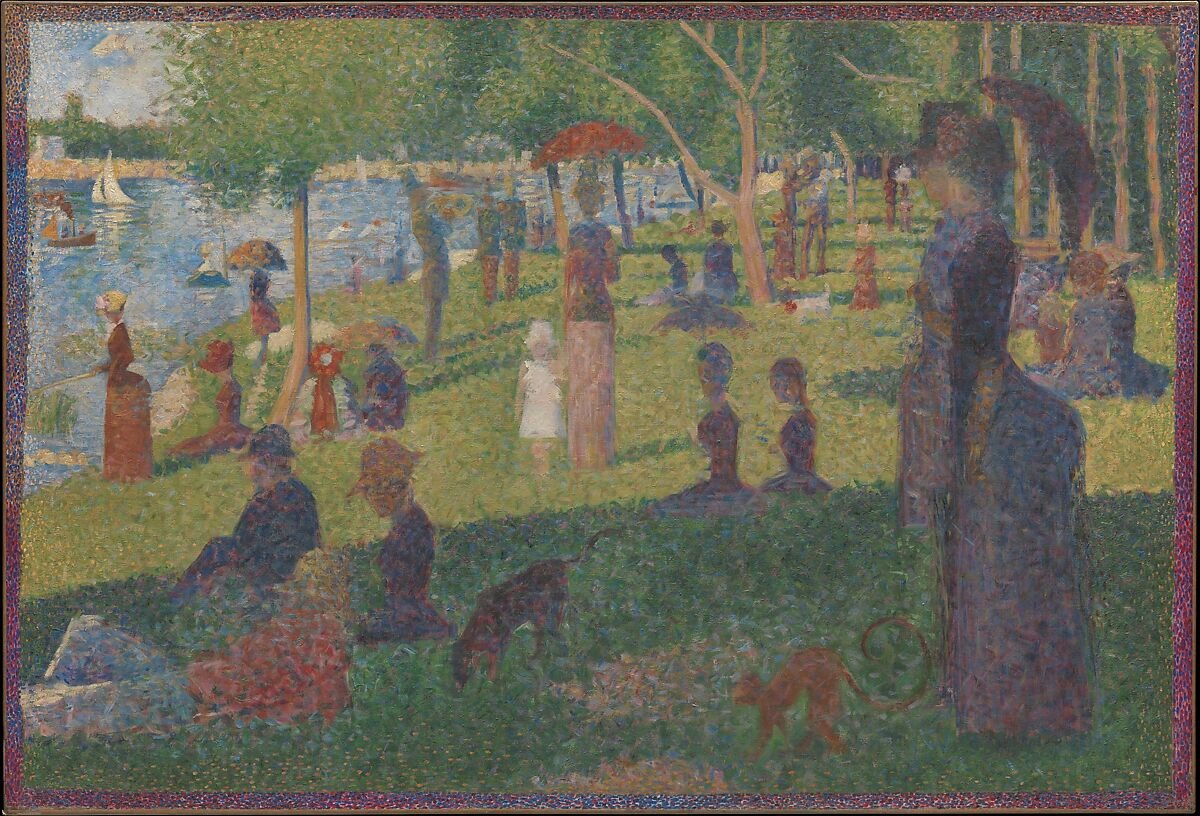
ANALYZE · OPEN-ACCESS COLLECTION
Observe the surface closely before naming a technique. The Met describes small, patchy brushstrokes in this study rather than uniform geometrical dots.
Rights: The Met marks the object image Public Domain and permits unrestricted use of its open-access public-domain images.
View the official Met object recordCHECK UNDERSTANDING
Usually not. When its boundary and interior dominate, shape is the more useful reading.
Their interval, relative direction, and the tension between two locations.
No. The marks remain discrete, while their density also produces tone and a larger field.
CONNECT