REGULAR
Equal treatment, equal interval.
A steady sequence creates a consistent visual beat.
PRINCIPLE 07 · VISUAL PACE
Recurrence, interval, accent, and variation create pace.
Rhythm begins when a visual event recurs and a viewer can compare the spaces, stresses, or changes between events. Equal repetition is only one possibility.
Keep the distinction clear: pattern identifies a repeat rule; rhythm describes pace, interval, and accent; movement describes a path or implied action.
CONTROLLED DEMONSTRATION 01
One motif cannot establish rhythm by itself. Once it returns, the distance between occurrences becomes part of the reading.
CONTROLLED DEMONSTRATION 02
Every example uses the same circular motif. Size, position, interval, or accent changes one relationship at a time.
REGULAR
A steady sequence creates a consistent visual beat.
ALTERNATING
The motif remains constant while vertical position alternates.
PROGRESSIVE
Here, increasing size creates an ordered transition.
SYNCOPATED · ANALOGY
“Syncopation” is borrowed from music as a useful analogy. The larger, outlined event interrupts the established visual beat.
FLOWING
The path bends, but the returning motif and intervals keep the sequence connected.
CONTROLLED DEMONSTRATION 03
The same motif can support three different questions. Name the relationship you are actually analyzing.
PATTERN
What repeats, and by what spatial system?
RHYTHM
How does the recurrence feel paced or stressed?
MOVEMENT
Where does attention travel, or what action is suggested?
VOCABULARY
Musical terms are analogies here. The page analyzes visible recurrence across space, not literal sound.
MANIPULATE · SEQUENCE EDITOR
The motif stays circular. Adjust recurrence, interval, mode, and accent; then describe what changed in the pace.
Regular: six equal beats recur at equal intervals; beat three is accented by size, outline, and color.
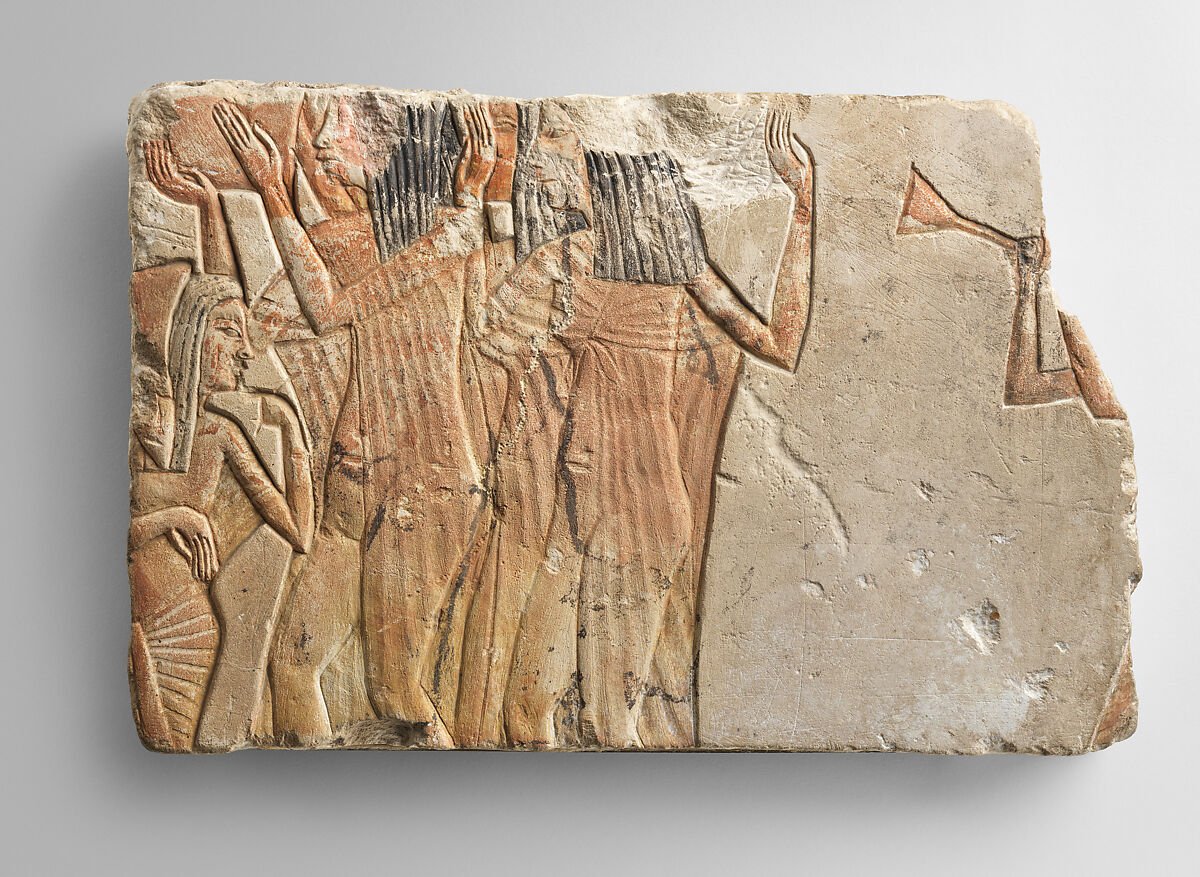
ANALYZE · OPEN-ACCESS COLLECTION
Begin with visible recurrence: standing bodies, raised arms, instruments, and the intervals between figures. The figures are not identical; variation keeps the sequence from becoming an even mechanical repeat.
Rights: The Met marks the object image Public Domain and permits unrestricted use of its open-access public-domain images.
View the official Met object recordCHECK UNDERSTANDING
The grid clearly demonstrates a pattern rule. It may also produce a regular rhythm, but first identify what repeats and how the field is generated.
Primarily movement: a single directional event can establish a path without recurrence.
The repeat supplies recurrence; the compressed gaps and recurring accent change the pace and stress of the rhythm.
CONNECT