FULL-DROP
Aligned horizontal and vertical rows.
PRINCIPLE 05 · REPEAT SYSTEM
An organized system in which a motif or unit repeats according to a rule.
To analyze a pattern, identify what repeats, locate the repeat unit, and describe the transformation or placement rule that extends it.
Pattern is the repeat structure. Rhythm is the pace. A fixed tiling can establish pattern without a strong sense of pace; recurrence with changing interval or accent can create rhythm.
CONTROLLED DEMONSTRATION 01
The boundary is visible here so the generating rule can be inspected. In a finished pattern, that boundary may become difficult to notice.
CONTROLLED DEMONSTRATION 02
The black L-shaped motif stays constant. Placement and transformation change.
Aligned horizontal and vertical rows.
Alternate columns offset by half a unit.
Alternate rows offset by half a unit.
The motif turns around repeated centers.
Alternating motifs mirror across an axis.
Units repeat around a shared center.
CONTROLLED DEMONSTRATION 03
When a motif crosses one tile edge, the corresponding fragment must continue from the opposite edge after translation.
DISTINCTION · PATTERN / RHYTHM
First identify the repeat system. Then ask how interval, accent, or progression affects pace.
MANIPULATE · REPEAT BUILDER
The L-shaped motif stays fixed. Compare placement and transformation systems, reveal the tile boundary, and introduce one controlled interruption only after the rule is legible.
Current rule: full-drop translation; rows and columns align. Tile boundaries are visible.
VOCABULARY
Identify the motif, the bounded unit, and the transformation that extends it.
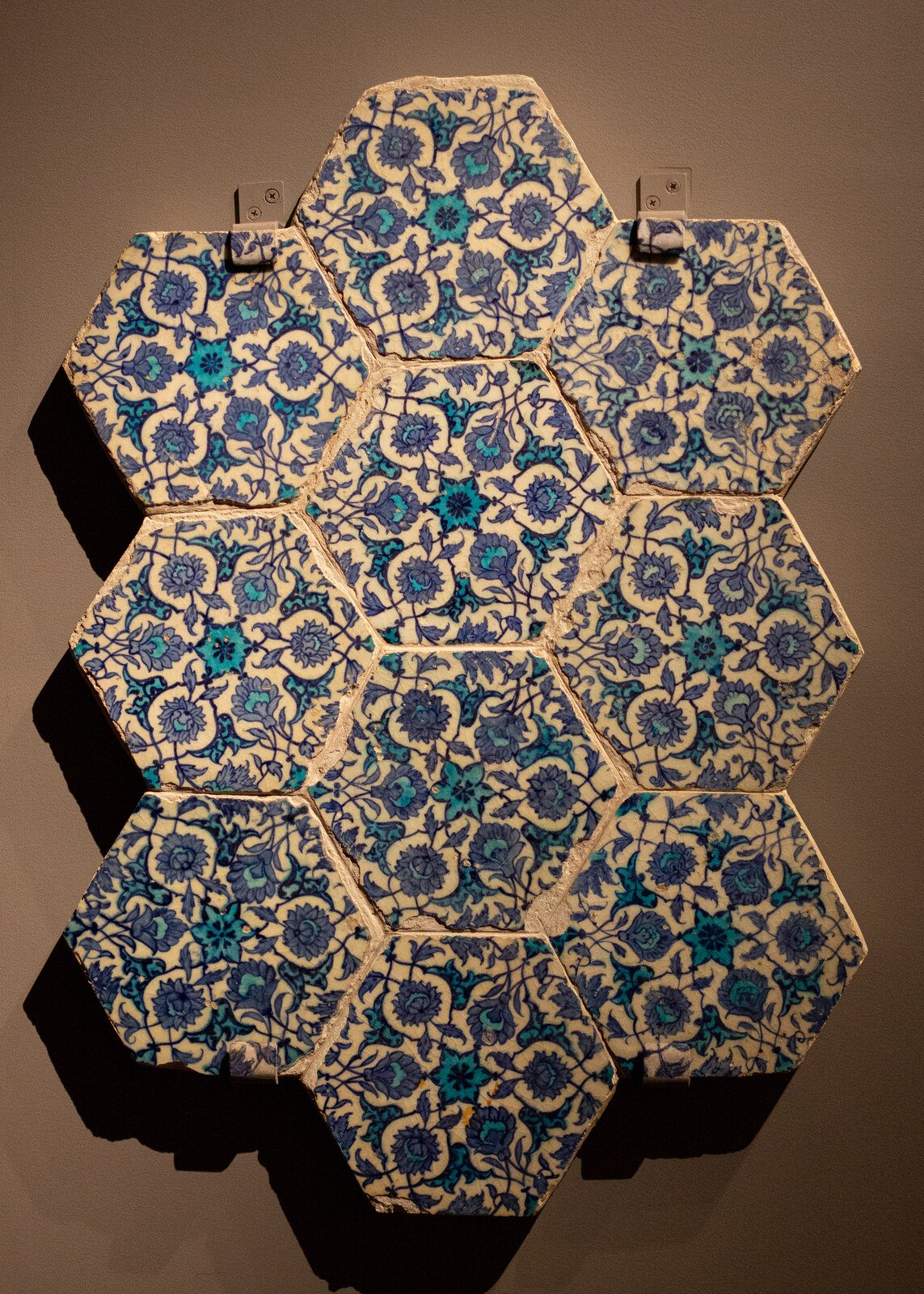
ANALYZE · MODULE AND CONTINUITY
Begin with observable structure. Seven hexagonal tiles remain visible as physical modules, while cobalt and turquoise stems, leaves, blossoms, and medallions continue across their boundaries.
Rights: the Met identifies the work and image as Public Domain and provides it through Open Access.
View the official Met object recordCHECK UNDERSTANDING
No. A tessellation specifically covers a plane without gaps or overlaps.
Yes. Variation or interruption becomes legible because an underlying repeat rule has already been established.
Pattern identifies the repeat structure. Rhythm describes the pace created through recurrence, interval, accent, or progression.
CONNECT