Value
The darker square is more prominent in this light field.
PRINCIPLE 01 · DISTRIBUTION
The perceived distribution of visual weight across a composition.
Visual weight is perceptual, not literal mass. Size, value, color, complexity, position, direction, and surrounding space can alter how strongly an element pulls attention.
Symmetry is one solution, not the definition of balance. Unlike elements can counterbalance one another, and purposeful imbalance can create useful tension.
CONTROLLED DEMONSTRATION 01
Each pair isolates one variable. The observations describe these controlled fields; they are not universal formulas for every image.
The darker square is more prominent in this light field.
The larger area exerts stronger visual pull.
Dense internal change can attract more attention than a plain area.
Unequal distance from the axis changes the distribution.
CONTROLLED DEMONSTRATION 02
Object count, shape, size, and color stay fixed. Only the arrangement changes.
DISTINCTION · BALANCE / UNITY
Balance: Where is visual weight distributed?
Unity: What makes the parts read as one coherent whole?
Weight corresponds; repeated shape and treatment connect the parts.
The sides counterbalance, but their visual languages do not strongly connect.
The circles belong together, while their weight gathers strongly on one side.
Both distribution and visual family are unsettled in this controlled example.
MANIPULATE · VISUAL WEIGHT
The left circle stays fixed. Change the right circle’s distance from the axis, size, and value. Test more than one solution; the lab does not assign a universal balance score.
Current comparison: equal size, equal value, and matched distance from the axis.
VOCABULARY
Name the arrangement and the variables that contribute to its visual weight.
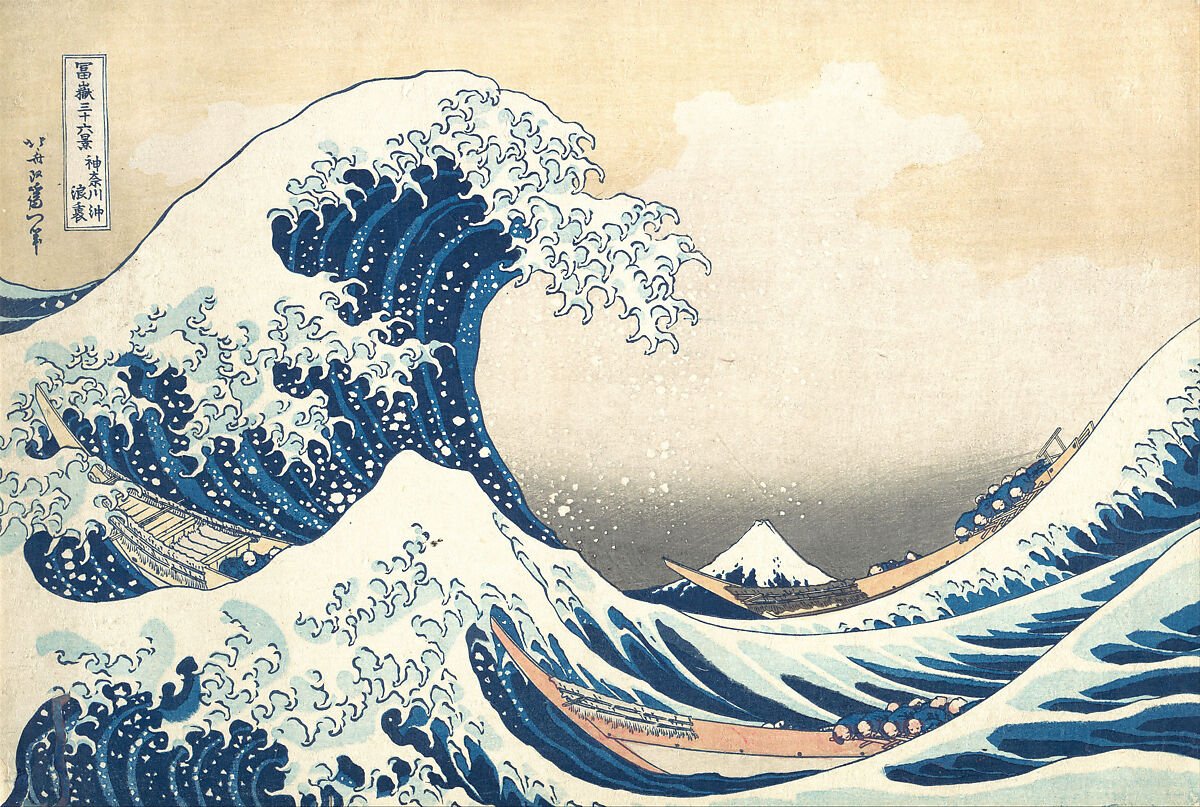
ANALYZE · ASYMMETRICAL BALANCE
Begin with observable distribution. The largest, darkest, and most intricate wave gathers weight at the left and upper center. Smaller boats, Mount Fuji, repeated curves, and broad open areas distribute attention across the remaining field.
Rights: the Met identifies the work and image as Public Domain and provides it through Open Access.
View the official Met object recordCHECK UNDERSTANDING
No. Asymmetrical balance uses unlike elements or placements to establish equilibrium without mirror correspondence.
Yes. Repeated attributes can make parts belong together even when their visual weight gathers strongly in one area.
No universal rule applies. In the controlled light field above it becomes more prominent, but surrounding color, scale, placement, context, and purpose can change the relationship.
CONNECT