Lean
A departure from a stable orientation can imply directional force.
PRINCIPLE 04 · DIRECTION
Implied physical action or a path along which attention is invited to travel.
A still image can suggest that a subject is acting, turning, falling, or continuing beyond the frame. Its composition can also connect areas into a route for attention.
Movement is not Rhythm. Movement may occur once as a directional event. Rhythm requires recurrence, interval, accent, or progression; rhythm can contribute to a path without becoming the same principle.
CONTROLLED DEMONSTRATION 01
The first panel suggests what a depicted form is doing. The second constructs a possible route among separate areas.
CONTROLLED DEMONSTRATION 02
These cues can support movement in context. None carries a universal emotional meaning by itself.
A departure from a stable orientation can imply directional force.
A form cut by the frame may appear to continue beyond it.
An oblique orientation establishes a directional event.
Successive states can act as a convention for change over time.
A facing direction can connect a figure with another area.
Aligned fragments can be perceived as one extending path.
CONTROLLED DEMONSTRATION 03
The violet guide records a compositional possibility created by the arrangement. It does not claim to record how every viewer actually looked.
DISTINCTION · MOVEMENT / RHYTHM
Ask whether the lesson concerns direction/action or paced repetition.
MANIPULATE · DIRECTIONAL STRUCTURE
The subject remains an abstract bar. Adjust its orientation and crop, then optionally reveal construction guides. The guide is a diagram of the composition, not a prediction of viewer behavior.
Current structure: an 18-degree rising orientation with 20% of the bar continuing beyond the frame.
VOCABULARY
Describe the visible cue before interpreting what it may suggest.
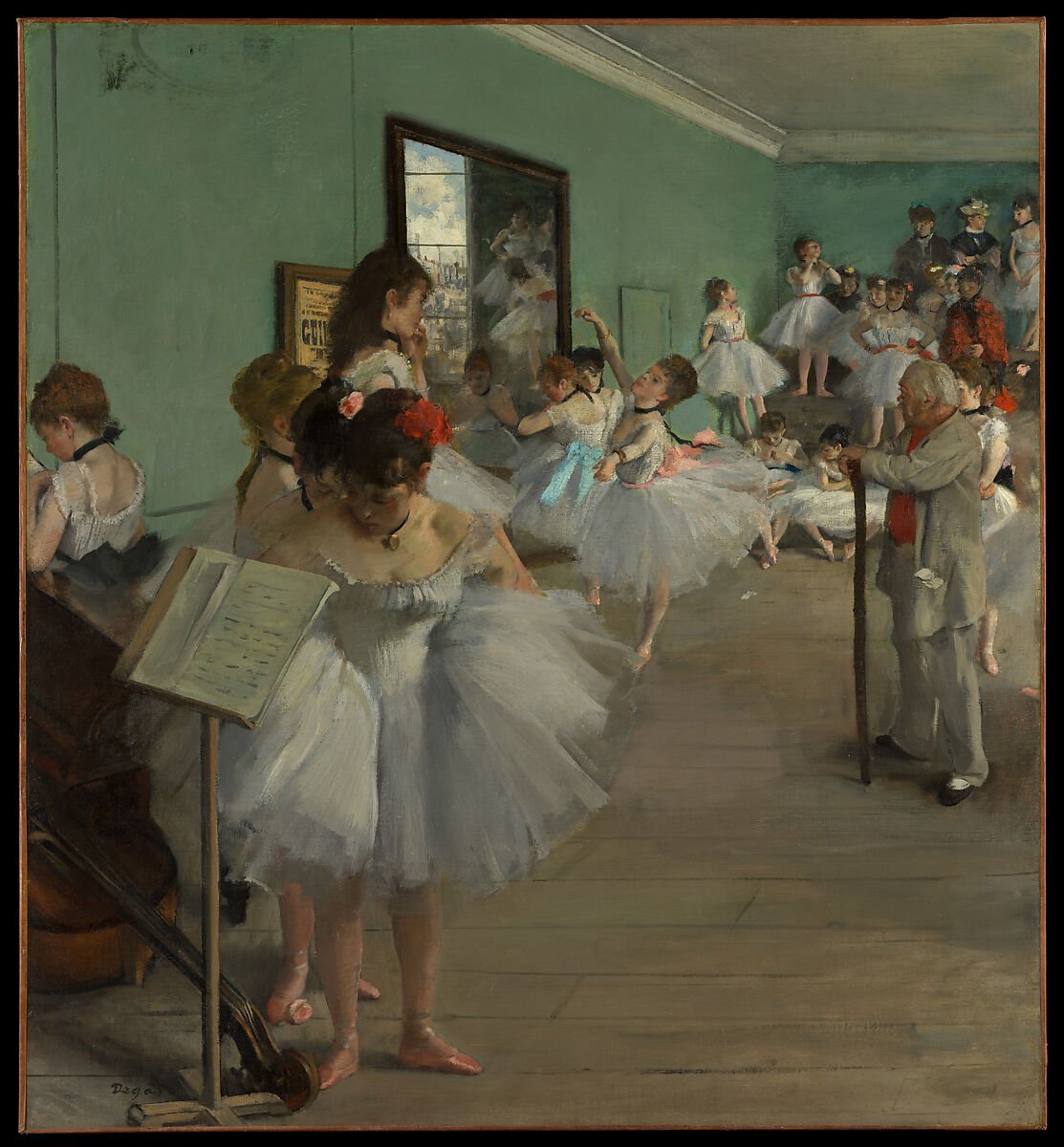
ANALYZE · ACTION AND ATTENTION
Begin with observable structure. Figures turn, bend, stand, and gesture in different directions. Cropped bodies enter the foreground, the floor tilts sharply into depth, and a curving succession of figures connects foreground, center, and background.
Rights: the Met identifies the work and image as Public Domain and provides it through Open Access.
View the official Met object recordCHECK UNDERSTANDING
Yes. One diagonal, crop, gesture, or directional event can imply action or establish a path.
No. A diagonal establishes orientation. Its effect depends on subject, scale, surrounding structure, and context.
Only when actual viewing behavior has been measured. Otherwise describe it as an inferred or invited attention path supported by visible cues.
CONNECT