BOUNDARY
A visible edge encloses the area.
The outline separates inside from outside. The shape remains flat even when its contour is complex.
ELEMENT 03 · TWO-DIMENSIONAL AREA
An area defined by boundary, closure, or contrast.
A shape is perceived when an area separates from its surroundings. A drawn outline can do that, as can an incomplete edge, a change in value, or a change in color.
Keep the distinction clear: a point is read primarily as a location; a shape is read through its area and boundary; a form has or implies three-dimensional volume.
CONTROLLED DEMONSTRATION 01
The area is similar in each example. Only the cue that defines it changes.
BOUNDARY
The outline separates inside from outside. The shape remains flat even when its contour is complex.
CLOSURE
The gaps remain visible, yet the separated segments provide enough evidence for one bounded area.
CONTRAST
No outline is drawn. The value change between the light area and dark field makes the boundary visible.
POINT → SHAPE THRESHOLD
At a small size, the circle is read mainly as a location: a point. As it occupies more of the field, its contour and interior become available for comparison, so it reads as a shape.
This is a shift in emphasis, not a fixed size rule. Context determines whether location or bounded area dominates.
CONTROLLED DEMONSTRATION 02
Geometric shapes tend toward regular construction and measurable relationships. Organic shapes tend toward irregular, complex contours. Many designed and natural shapes contain qualities of both.
Use the terms to describe visible structure rather than to decide whether something is “natural,” “made,” good, or bad.
CONTROLLED DEMONSTRATION 03
The same circle and rectangle can remain separate, overlap, be cropped by the frame, or interlock.
VOCABULARY
These terms describe how an area becomes legible and how it behaves beside other areas.
MANIPULATE · FIGURE–GROUND
The image itself does not change. Your reading does. Choose a region, then use the visible outline and text description to confirm the selected figure.
Current reading: the white center is the figure; the black profiles are ground.
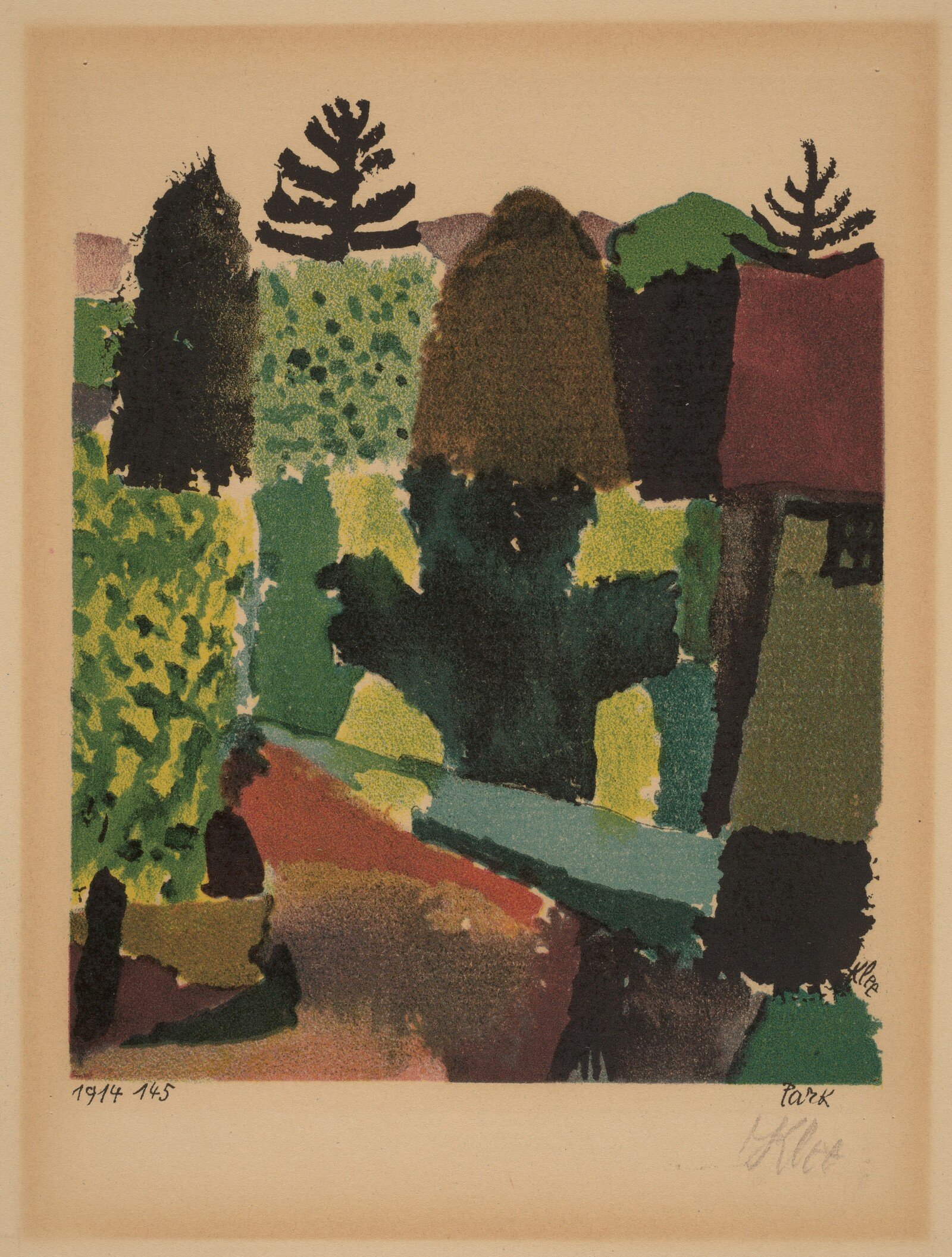
ANALYZE · OPEN-ACCESS COLLECTION
Begin with what is visible: bounded blocks, irregular silhouettes, overlap, and layered areas of color. Ask where a contour is explicit and where adjacent areas create an edge without an outline.
Rights: the NGA record states that this object’s media is free and in the public domain.
View the official NGA object recordCHECK UNDERSTANDING
It may read primarily as a point because location and focus dominate. Enlarge or crop it until its contour and interior become important, and it begins to read as shape.
Yes. Contrast can establish a boundary even when no line is drawn.
The circle is a shape, but the shading may create the illusion of form. Name the flat area and the depth cue separately.
CONNECT