PRINCIPLE 09 · CONTROLLED DIFFERENCE
Variety.
A range of differences operating within a composition or established visual system.
Variety begins with relationship. Establish a family, motif, rule, or shared treatment, then ask what changes, by how much, and where.
Unity creates coherence; variety introduces difference. A composition can use both simultaneously. Random changes without an established relation do not demonstrate variety clearly.
CONTROLLED DEMONSTRATION 01
Vary one attribute; preserve the base form.
Every row starts with the same square motif. Only the named variable changes.
CONTROLLED DEMONSTRATION 02
Compare ranges; do not assign a universal winner.
These are diagnostic states, not quality verdicts. Purpose, audience, medium, and context determine which range is useful.
DISTINCTION · VARIETY / CONTRAST
Range and opposition answer different questions.
Variety concerns the range and distribution of differences across a whole. Contrast describes a degree of difference between selected elements or areas.
MANIPULATE · CONTROLLED VARIETY
Change the range; keep a shared rule visible.
Choose how many attributes can vary, then set the degree of change. The field remains anchored to a repeated square family and an underlying grid so difference stays relational.
Current state: one attribute varies slightly. Contour, palette, and grid remain shared.
VOCABULARY
Describe both continuity and change.
Name the base relationship before evaluating the range of differences.
- Variety
- A range of differences within a composition or system.
- Variation
- A change made to a shared base form or rule.
- Range
- The span between least and most differentiated instances.
- Contrast
- A degree of difference between specific elements.
- Repetition
- Recurrence that establishes continuity.
- Restraint
- Limiting variables or range to support purpose.
- Visual rest
- A comparatively quiet area that offsets complexity.
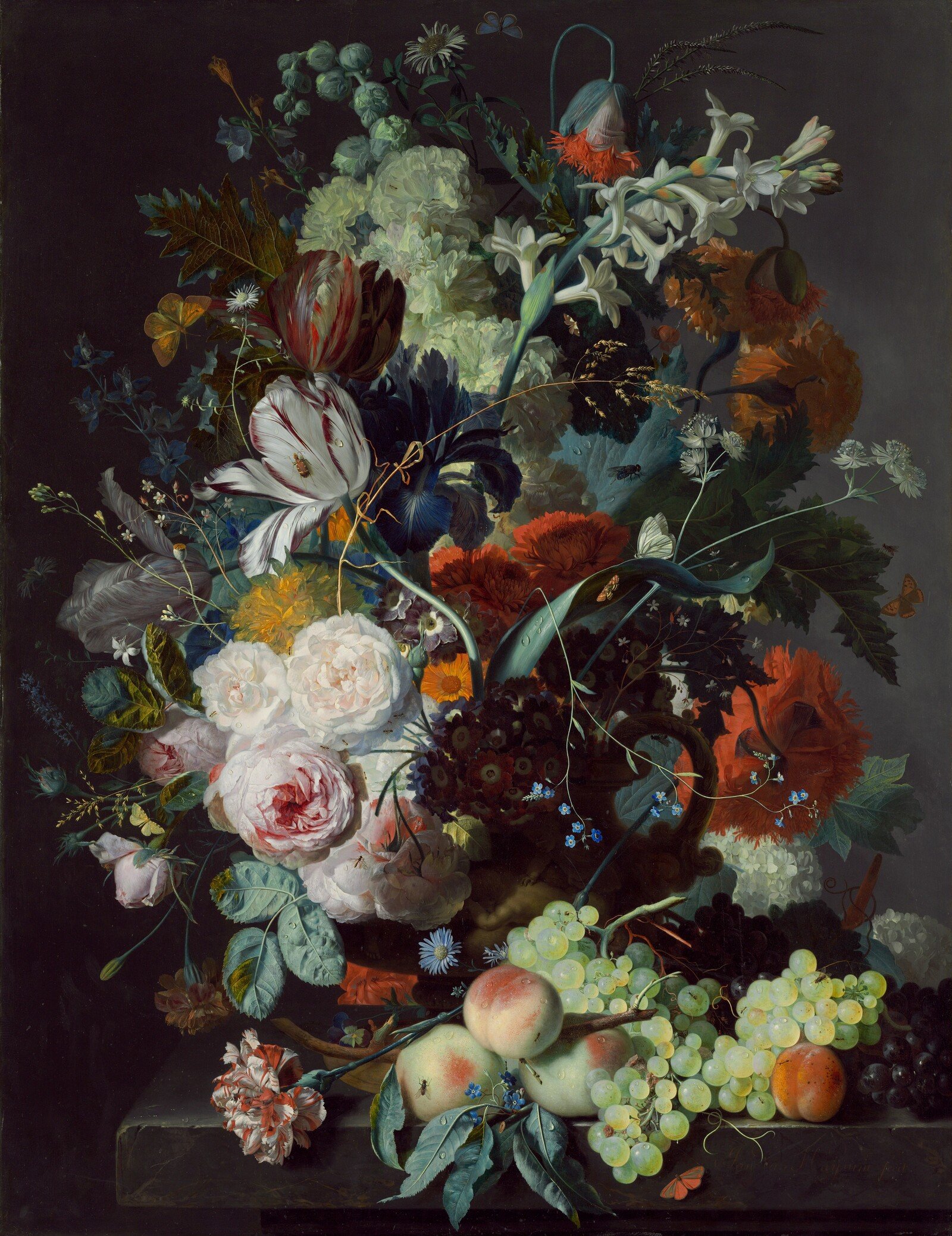
ANALYZE · DIFFERENCE WITHIN A SYSTEM
Still Life with Flowers and Fruit
Begin with visible evidence. Blossoms, stems, fruit, leaves, insects, and water drops differ in contour, scale, hue, surface, and orientation. The dark ground, concentrated bouquet, shared illumination, vessel, and ledge maintain larger organizing limits.
- List four attributes that vary across the flowers and fruit.
- Which repeated or continuous relationships prevent every detail from reading as unrelated?
- Where does the composition offer comparatively quiet areas or visual rest?
Rights: the NGA states that this object’s media is free and in the public domain and releases open-access images under CC0.
View the official NGA object recordCHECK UNDERSTANDING
What changes, and what still connects?
Is variety the same as randomness?
No. Variety is legible as difference within an established relationship or system. Unbounded change can obscure that relationship.
Is variety the opposite of unity?
No. Unity creates coherence while variety introduces difference. The same composition can use both.
Is more variety always better?
No. The useful range depends on communicative purpose, audience, medium, and context.
How is variety different from contrast?
Variety describes the range and distribution of differences across a whole. Contrast describes the degree of difference between selected elements or areas.
CONNECT