PRINCIPLE 06 · SIZE RELATIONSHIPS
Proportion
& Scale.
Proportion relates parts to parts or a whole. Scale relates size to an external reference or context.
Proportion asks: How large is one part compared with another part or the whole?
Scale asks: How large is the whole compared with a body, object, environment, measure, convention, or other understood reference?
An object can change scale while preserving every internal proportion. One part can change proportion while the object’s overall size remains fixed.
CONTROLLED DEMONSTRATION 01
Overall size stays fixed; internal ratios change.
All three figures occupy the same outer height and width. Only the division between upper and lower parts changes.
CONTROLLED DEMONSTRATION 02
Internal ratios stay fixed; reference changes meaning.
Each tower keeps the same 40:60 internal division. A fixed human reference makes the tower’s changing scale legible.
CONTROLLED DEMONSTRATION 03
Two variables; four controlled states.
Read horizontally to compare proportion at one scale. Read vertically to compare scale at one proportion.
DISTINCTION · PHYSICAL / COMMUNICATIVE SIZE
Large on the page does not always mean physically large.
Scale hierarchy uses relative size to signal importance. Literal scale compares depicted or actual size against a reference.
MANIPULATE · TWO INDEPENDENT VARIABLES
Change proportion or scale. See the difference.
The violet upper part and black lower part form one object. Internal ratio changes their division while the outer height stays constant. Overall size scales the complete object beside a fixed human reference.
Current state: proportion is 40:60; overall scale is 100% beside the fixed reference.
VOCABULARY
Name the relationship before judging it.
Specify whether the comparison is internal or depends on an external reference.
- Proportion
- A dimensional relation between parts or between a part and whole.
- Ratio
- A quantitative comparison between dimensions or amounts.
- Scale
- Size relative to an external reference or context.
- Scale reference
- A familiar object, body, measure, or convention used for comparison.
- Scale hierarchy
- Relative size used to signal importance rather than literal physical size.
- Module
- A unit used to organize repeated dimensions or ratios.
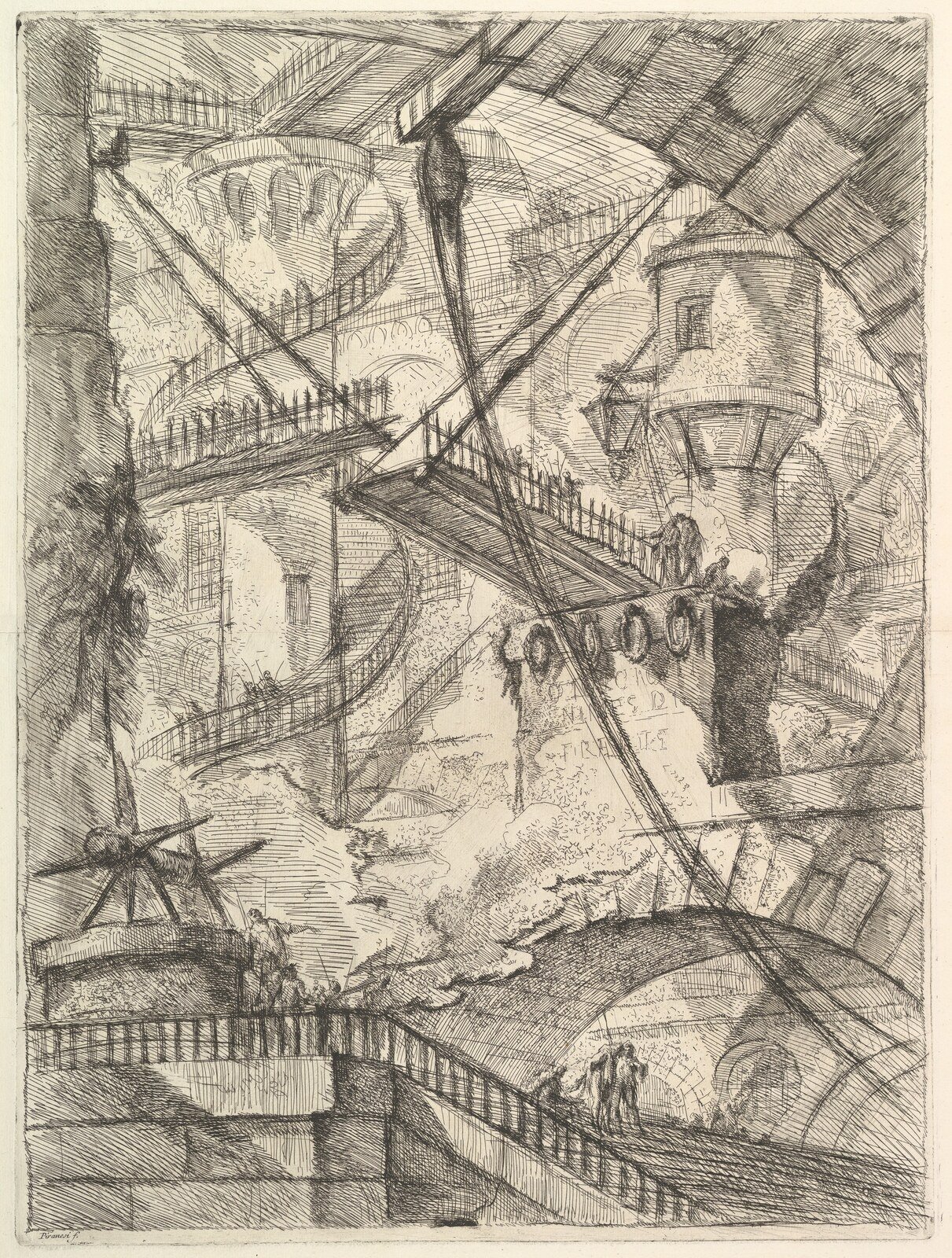
ANALYZE · INTERNAL RATIO AND REFERENCE
The Drawbridge
Begin with observable comparisons. Massive piers, stairs, platforms, arches, ropes, and the drawbridge divide the sheet into unequal architectural parts. Small human figures provide an external reference against which those structures appear immense.
- Compare the width and height of two architectural parts.
- Find a human figure and use it as a scale reference.
- Which observations concern internal proportion, and which depend on external scale?
Rights: the Met identifies the work and image as Public Domain and provides it through Open Access.
View the official Met object recordCHECK UNDERSTANDING
Which relationship changed?
If an entire model doubles in size, must its proportion change?
No. Every internal ratio can remain constant while the model’s scale changes relative to a person or environment.
If one part grows while the outer size stays fixed, what changes?
Proportion. The part-to-part and part-to-whole ratios change.
Is the golden ratio a universal rule for good design?
No. It is one historical proportional system among many, not an inherently superior or universal standard.
CONNECT