ACTUAL LINE
The mark is continuous.
A visible stroke supplies the path directly from one location to another.
ELEMENT 02 · PATH, TRACE, EDGE
A path, trace, edge, or directional relation that the eye follows.
A line can be drawn, scratched, cut, aligned, or inferred. It can describe a boundary, travel across a surface, accumulate into value, or connect separated events.
Keep the distinction clear: a line is a visible or implied path. An edge can be perceived between areas even when no line is drawn.
CONTROLLED DEMONSTRATION 01
The path is continuous in one example and assembled perceptually in the others.
ACTUAL LINE
A visible stroke supplies the path directly from one location to another.
IMPLIED · ALIGNMENT
No stroke joins the points, but their alignment makes a path available to the eye.
IMPLIED · FRAGMENTS
Repeated edge fragments point along a common course without becoming one continuous mark.
CONTROLLED DEMONSTRATION 02
Horizontal, vertical, diagonal, and curved paths organize space differently. Their emotional associations are interpretations, not universal facts.
CONTROLLED DEMONSTRATION 03
The same rounded form is used so the function of each line system remains visible.
CONTOUR
Contour follows the boundary between the form and its surrounding field.
CROSS-CONTOUR
Its changing curve suggests how the volume turns rather than merely tracing its outside edge.
HATCHING
Direction, spacing, and weight create value and texture while remaining visibly linear.
VOCABULARY
A precise label explains what the line contributes, not what mood it supposedly guarantees.
MANIPULATE · LINE CHARACTER
Weight, curvature, continuity, and repetition are visible variables. Adjust one at a time and describe evidence rather than assigning a preset emotion.
Observation: one medium-weight, moderately curved, continuous line establishes a single path.
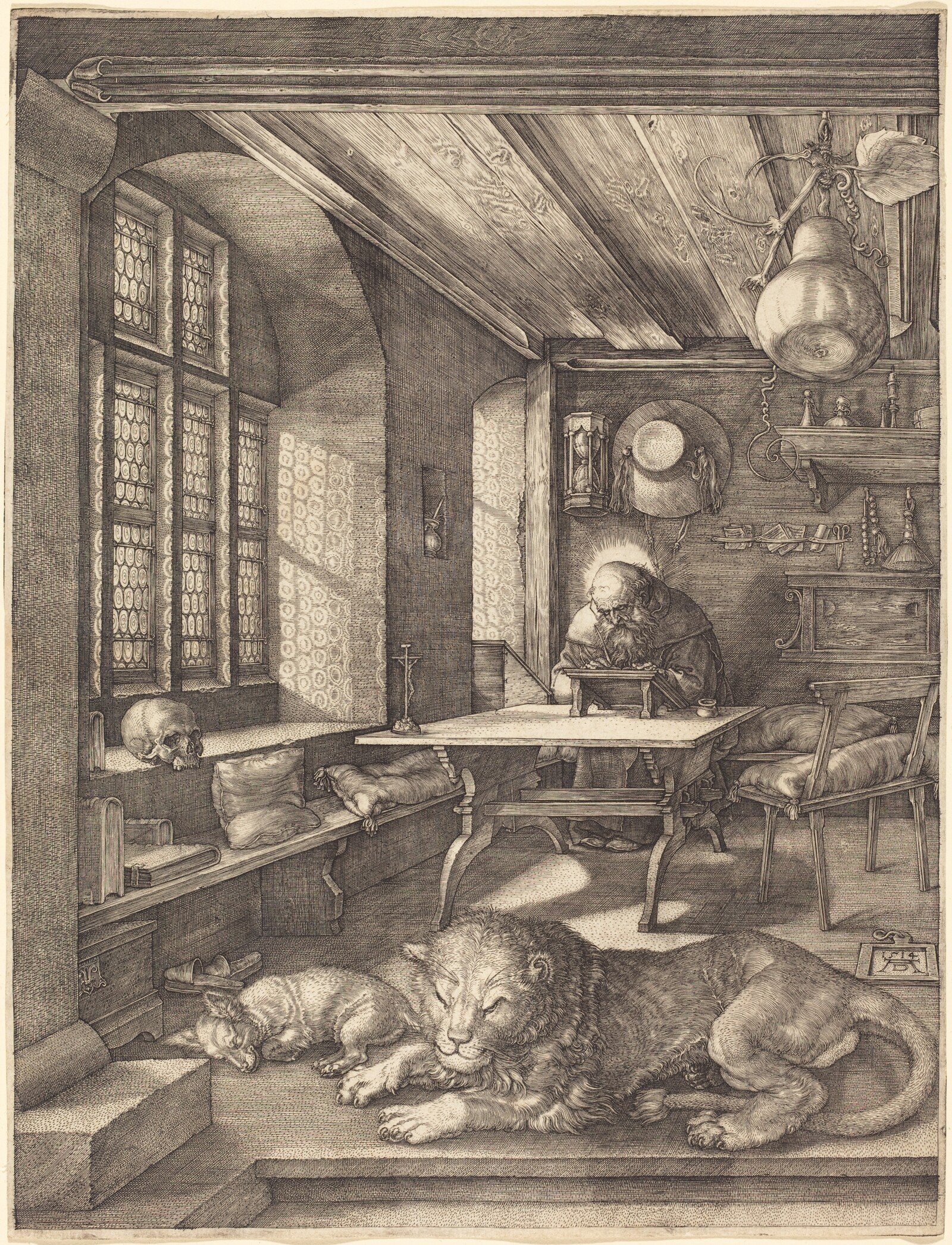
ANALYZE · OPEN-ACCESS COLLECTION
Begin with visible line behavior: direction, interval, weight, and density. The engraved marks describe contours, surfaces, materials, light, and depth rather than functioning as outlines alone.
Rights: the NGA record states that this object’s media is free and in the public domain.
View the official NGA object recordCHECK UNDERSTANDING
No. It is a perceived edge. A line may be added there, but contrast alone can establish the boundary.
Cross-contour. The lines travel across the surface rather than only describing its outside edge.
An implied line created by alignment and interval.
CONNECT