ELEMENT 05 · RELATIVE LIGHT AND DARK
Value.
The relative lightness or darkness of a color or neutral.
Value is relational. We judge an area as lighter than, darker than, or similar to another area. Its appearance can change when the surrounding values change.
Value is not an “amount of black.” Every perceived color has relative lightness, and different hues can occupy similar value positions.
CONTROLLED DEMONSTRATION 01
The same gray can look different.
The two center squares are identical. Their surrounding fields change the comparison.
Both center squares: #777777
CONTROLLED DEMONSTRATION 02
A scale orders relationships.
Nine steps provide a practical instructional sequence from dark to light; they are not a claim of perfectly equal perceptual intervals.
CONTROLLED DEMONSTRATION 03
Group many values into three masses.
Value reduction groups numerous local light/dark differences into a few larger value families while preserving the major light–dark structure.
The composition does not change here. Every silhouette, crop, object position, and spatial relationship is identical; only the value assignments collapse into light, mid, and dark.
CONTROLLED DEMONSTRATION 04
Key describes where most values gather.
The composition stays similar while its range shifts toward light, middle, or dark values.
COLOR ALSO HAS VALUE
Different hues can share similar lightness.
The purple and green swatches differ in hue but are adjusted to a similar relative lightness. A grayscale check suppresses hue so their value relationship is easier to compare.
For text accessibility, visual impressions are not enough: calculate the contrast ratio of the actual foreground and background pair.
VOCABULARY
Organize light and dark precisely.
These terms distinguish a single comparison from the structure of an entire composition.
- Value
- Relative lightness or darkness.
- Value scale
- An ordered sequence from dark to light.
- Value range
- The distance between the darkest and lightest values used.
- Key
- The overall concentration of values in a light, middle, or dark range.
- Value contrast
- The difference in lightness between adjacent areas.
- Notan
- A historically situated design study of light and dark masses, not a generic synonym for every value study.
MANIPULATE · VALUE SCALE
Change the range and count the steps.
Step count changes how finely the interval is divided. Overall shift lightens or darkens every step while preserving the ordered relationship until an endpoint clips.
Compare adjacent steps for local contrast; compare the endpoints for overall range.
Comparison: seven ordered steps span the full dark-to-light range.
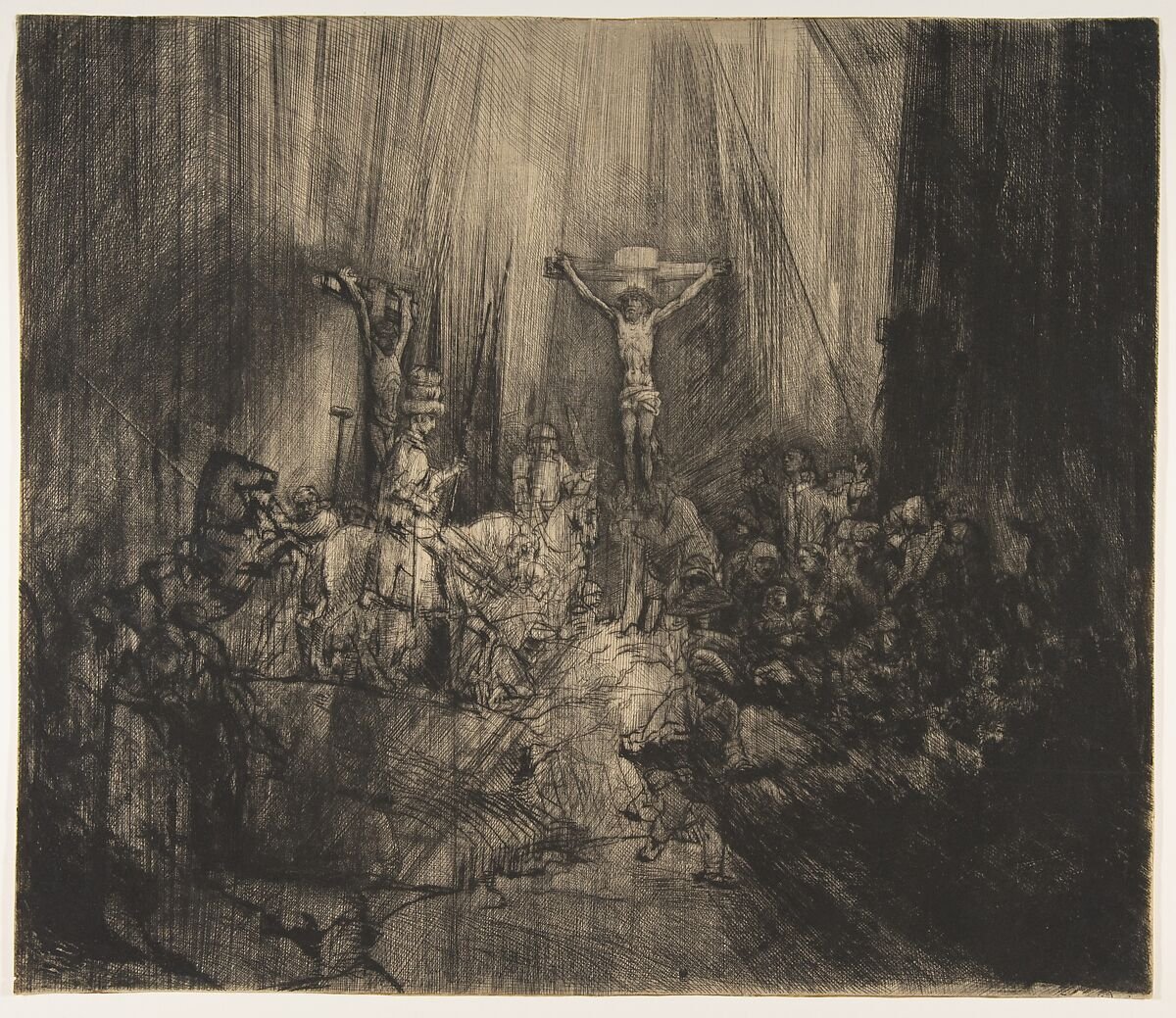
ANALYZE · OPEN-ACCESS COLLECTION
Christ Crucified between the Two Thieves: The Three Crosses
Begin with large light, middle, and dark masses before examining figures or individual marks. Dense drypoint and exposed paper establish the broad value structure.
- Where is the largest light mass?
- Which dark areas merge, and which retain visible internal variation?
- How does the value range affect edge clarity around the central cross?
Rights: The Met marks the object image Public Domain and permits unrestricted use of its open-access public-domain images.
View the official Met object recordCHECK UNDERSTANDING
Which relationship are you judging?
Two different colors become nearly identical in grayscale. What do they share?
They have a similar relative value, even though their hues differ.
A painting uses only pale grays but still separates adjacent shapes clearly. High key or low contrast?
It is high key. Its local contrast may still be sufficient; key and contrast describe different relationships.
Does visible contrast automatically satisfy WCAG accessibility requirements?
No. WCAG text contrast is a measured ratio for a specific foreground/background pair. Pictorial value contrast is related but not interchangeable.
CONNECT