ELEMENT 08 · FIELD, INTERVAL, DEPTH

Space.

The field and the perceived or physical intervals, depths, volumes, and voids within it.

Space is not leftover background. Margins, intervals, occupied areas, openings, and depth relationships actively organize what can be seen and understood.

Perspective is not the whole subject. Overlap, relative size, placement, convergence, contrast, detail, and atmospheric change can each contribute to spatial perception.

ORIENTATION · THE PICTURE PLANE

Occupied and unoccupied areas define one another.

The black regions are read as occupied positive space. The white channel between them is negative space, but it is deliberately shaped rather than treated as accidental emptiness.

Positive and negative describe a spatial relationship, not good and bad values. Either region can become perceptually prominent.

Interlocking positive and negative spaceThree black occupied shapes create a continuous white zigzag interval that has been intentionally shaped.POSITIVE SPACENEGATIVE SPACE
The interval is continuous, bounded, and composed rather than merely unused.

CONTROLLED DEMONSTRATION 01

Intervals can create groups.

The six identical circles do not change. Only the distances between them change, altering which circles appear related.

CLOSE INTERVALSTwo groups become likely.
WIDER INTERVALSThe grouping becomes less definite.

CONTROLLED DEMONSTRATION 02

Depth has more than one cue.

Each panel isolates a different source of spatial evidence. In actual images, several cues often operate together.

Overlap

Occlusion establishes which form is in front.

Relative size

When comparable objects differ in image size, the smaller may read as farther away.

Vertical placement

In some pictorial viewpoints, higher placement can support distance; it is not a universal rule.

Contrast + detail

Reduced edge contrast and detail can support atmospheric distance.

CONTROLLED DEMONSTRATION 03

Perspective systems organize recession.

Linear perspective uses geometry. Atmospheric perspective uses changes in contrast and detail. Neither is synonymous with space itself.

One-point perspective constructionA horizon and central vanishing point organize four orthogonals through corresponding corners of a large foreground rectangle and a smaller distant rectangle.VANISHING POINTHORIZONORTHOGONALS CONVERGE
LINEAR PERSPECTIVEConverging parallel directions construct depth toward a vanishing point.
Atmospheric depth through controlled contrast and detailThree repeated mountain layers become lighter, lower contrast, and less detailed as they recede.
ATMOSPHERIC PERSPECTIVEDistant layers lose contrast and fine detail; no fixed hue formula is implied.

MANIPULATE · DEPTH CUES

Build depth one cue at a time.

All three objects begin equal and separate. Add overlap, relative scale, vertical placement, and contrast/detail independently to see how each variable contributes.

Active cues: none. The objects remain equal and separate.

VOCABULARY

Describe the field and the depth cue.

Name the specific evidence rather than saying only that an image “has perspective.”
Positive space
Area occupied or read as figure.
Negative space
Area around and between figures.
Proximity
Nearness that can imply grouping.
Overlap
One form occluding part of another.
Linear perspective
A geometric system using convergence toward vanishing point(s).
Atmospheric perspective
Depth suggested through reduced contrast, detail, and/or color shift with distance.
Picture plane
The flat surface or implied plane of an image.
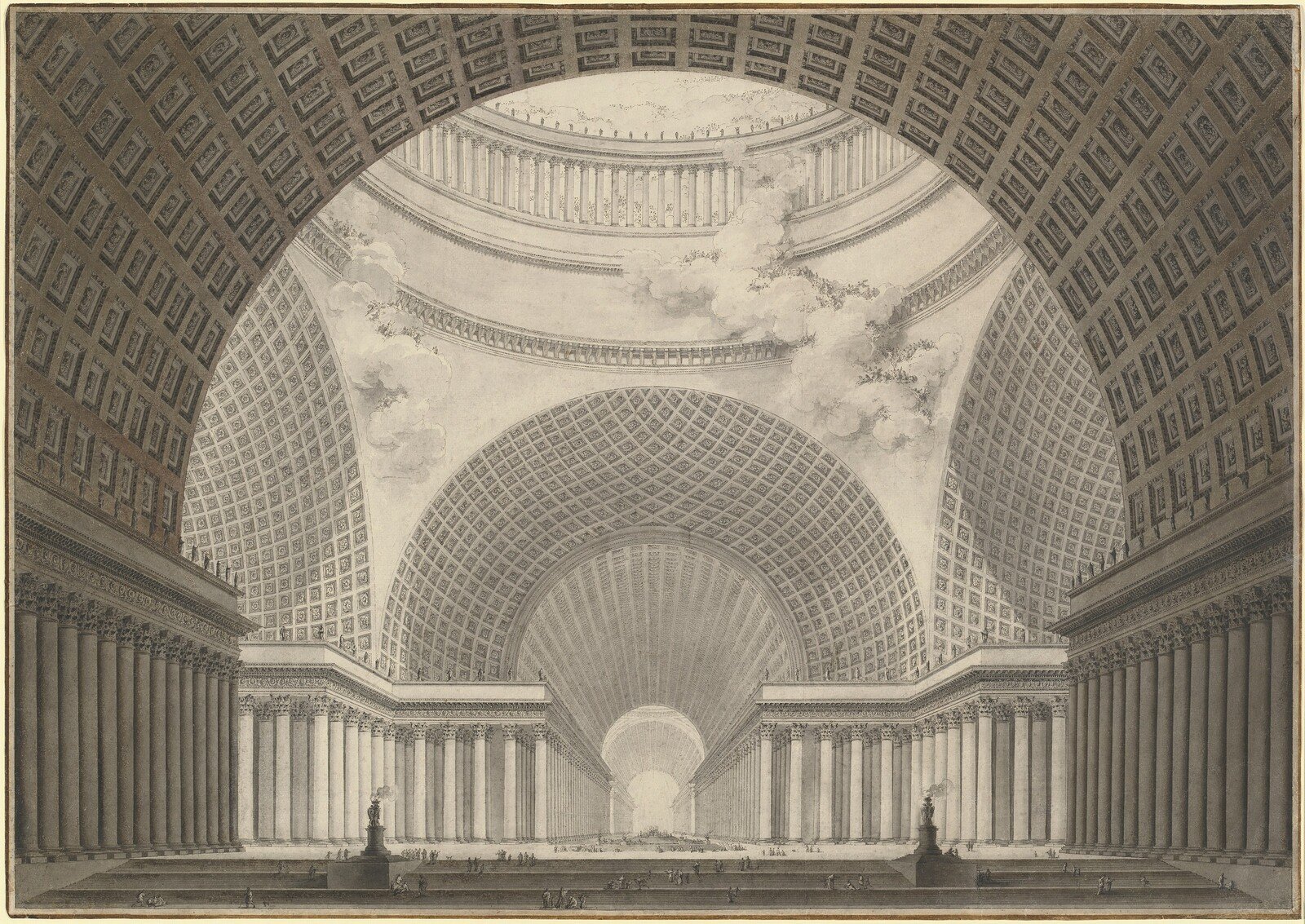
Étienne-Louis Boullée's architectural drawing of a vast metropolitan church interior with monumental arches, repeated columns, stairs, and tiny human figures.
Image: National Gallery of Art, Washington. Free and in the public domain.

ANALYZE · MULTIPLE DEPTH CUES

Perspective View of the Interior of a Metropolitan Church

Étienne-Louis Boullée · 1780/1781
Pen and black ink with gray and brown wash over graphite on laid paper, with framing line in brown chalk
National Gallery of Art, Washington · Accession 1991.185.1
Credit line: Patrons’ Permanent Fund

Begin with observable spatial evidence: repeated columns diminish, architectural lines converge, nearer forms overlap farther forms, and tiny figures provide a human scale reference.

  1. Trace two orthogonals toward the distant opening.
  2. Where does repetition become smaller or more closely spaced?
  3. Which value and detail changes separate foreground, middle distance, and far distance?

Rights: the NGA record states that this object’s media is free and in the public domain.

View the official NGA object record

CHECK UNDERSTANDING

Which cue is doing the work?

Two equal shapes touch, but neither covers the other. Is overlap established?

No. Overlap requires occlusion: one shape must interrupt part of another.

Does placing a shape higher always make it farther away?

No. Higher placement can support distance in particular viewpoints and pictorial conventions, but it is not a universal law.

How is atmospheric perspective different from linear perspective?

Atmospheric perspective changes contrast, detail, and sometimes color with distance. Linear perspective organizes directions geometrically through convergence.

CONNECT

Space is shaped by edges, volumes, and size relations.