Lean
A departure from a stable orientation can imply directional force.
PRINCIPLE 04 · DIRECTION
Implied physical action or a path along which attention is invited to travel.
A still image can suggest that a subject is acting, turning, falling, or continuing beyond the frame. Its composition can also connect areas into a route for attention.
Movement is not Rhythm. Movement may occur once as a directional event. Rhythm requires recurrence, interval, accent, or progression; rhythm can contribute to a path without becoming the same principle.
BEFORE YOU EXPERIMENT
Movement in a still composition can mean an action represented by a subject or a route that visual relationships invite your eye to follow. A dancer’s lifted arm may suggest a continuing gesture. Repeated angled forms can connect distant areas into a possible viewing path. These are related but distinct claims: one concerns what appears to be happening in the scene, and the other concerns how a viewer may explore the image. Neither needs actual animation. Name the visible cues before describing a direction.
A designer arranging a sequence of instructions can use arrows, numbering, alignment, and spacing to lead a reader from one step to the next. If a large photograph pulls attention to the last step first, the sequence may become harder to follow. Moving the photograph or strengthening the first number could clarify the route. Yet no designer can prescribe the exact order every person will see. You can propose a likely path, then check it with viewers. The Rhythm lesson addresses recurring beats and intervals; a single strong directional cue can establish movement without a repeat.
Edgar Degas’s The Dance Class (1874) gives you both kinds of movement to consider. Look for bodily poses that imply action and for compositional relationships that bring your attention among the figures and the surrounding room. Describe each claim separately rather than saying that the whole painting “moves” without evidence. The Metropolitan Museum of Art holds this oil painting as object 1987.47.1, Bequest of Mrs. Harry Payne Bingham, 1986, and marks the image Public Domain. The artwork study below links its official object record and offers prompts for tracing a route.
One misconception is that a diagonal automatically means speed. Its effect depends on the subject, surrounding lines, and the amount of visual competition. Another is that a viewing path is an invisible line every observer must follow. People bring different tasks and experiences to an image. An analysis can still identify plausible routes through gaze direction, overlap, repeated angles, or aligned edges, as long as it treats them as invitations rather than guarantees. Line helps name the actual or implied paths that support those readings.
CONTROLLED DEMONSTRATION 01
The first panel suggests what a depicted form is doing. The second constructs a possible route among separate areas.
CONTROLLED DEMONSTRATION 02
These cues can support movement in context. None carries a universal emotional meaning by itself.
A departure from a stable orientation can imply directional force.
A form cut by the frame may appear to continue beyond it.
An oblique orientation establishes a directional event.
Successive states can act as a convention for change over time.
A facing direction can connect a figure with another area.
Aligned fragments can be perceived as one extending path.
CONTROLLED DEMONSTRATION 03
The blue guide records a compositional possibility created by the arrangement. It does not claim to record how every viewer actually looked.
DISTINCTION · MOVEMENT / RHYTHM
Ask whether the lesson concerns direction/action or paced repetition.
MANIPULATE · DIRECTIONAL STRUCTURE
The subject remains an abstract bar. Adjust its orientation and crop, then optionally reveal construction guides. The guide is a diagram of the composition, not a prediction of viewer behavior.
Current structure: an 18-degree rising orientation with 20% of the bar continuing beyond the frame.
VOCABULARY
Describe the visible cue before interpreting what it may suggest.
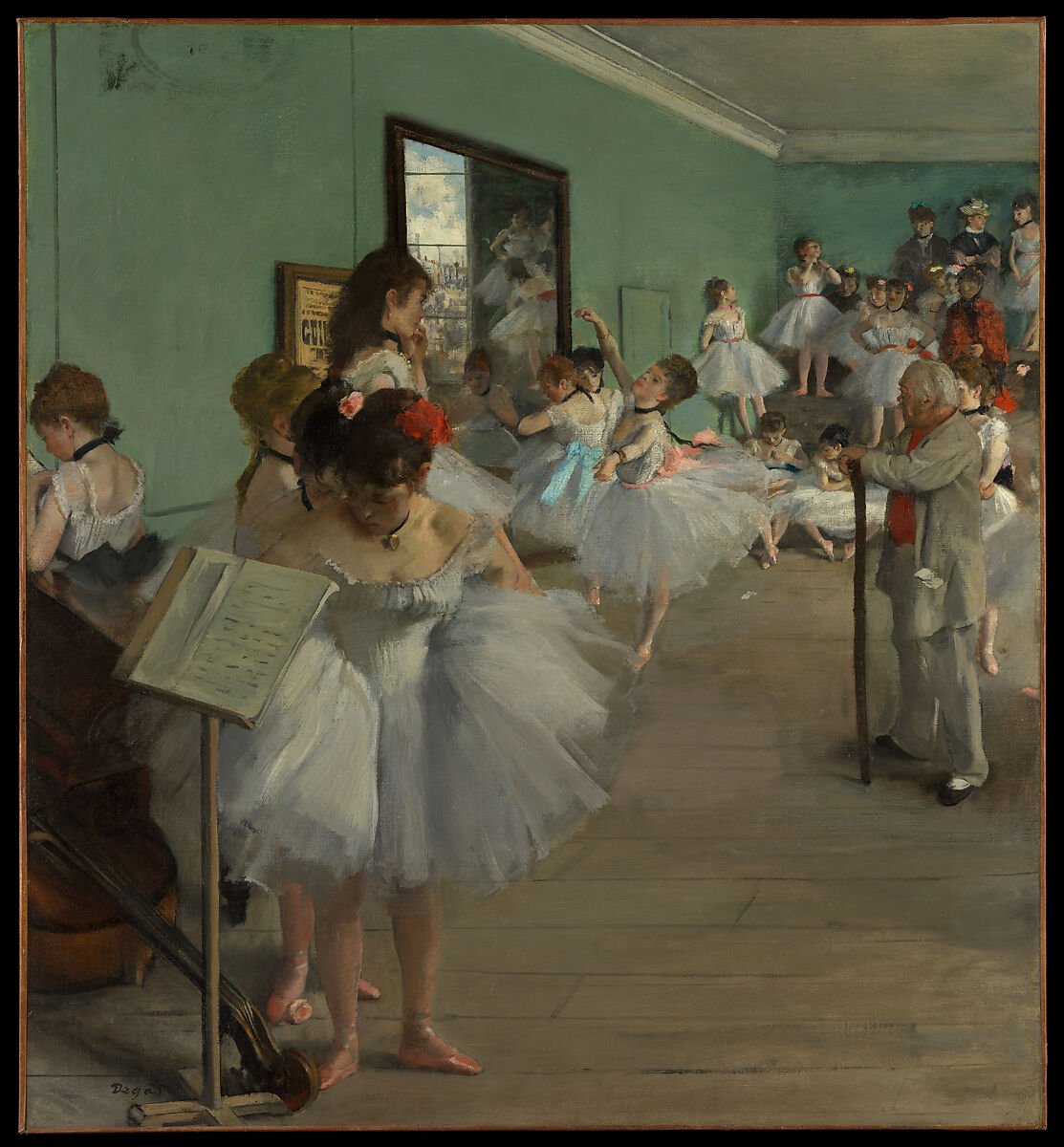
ANALYZE · ACTION AND ATTENTION
Begin with observable structure. Figures turn, bend, stand, and gesture in different directions. Cropped bodies enter the foreground, the floor tilts sharply into depth, and a curving succession of figures connects foreground, center, and background.
Rights: the Met identifies the work and image as Public Domain and provides it through Open Access.
View the official Met object recordCHECK UNDERSTANDING
Yes. One diagonal, crop, gesture, or directional event can imply action or establish a path.
No. A diagonal establishes orientation. Its effect depends on subject, scale, surrounding structure, and context.
Only when actual viewing behavior has been measured. Otherwise describe it as an inferred or invited attention path supported by visible cues.
CONNECT