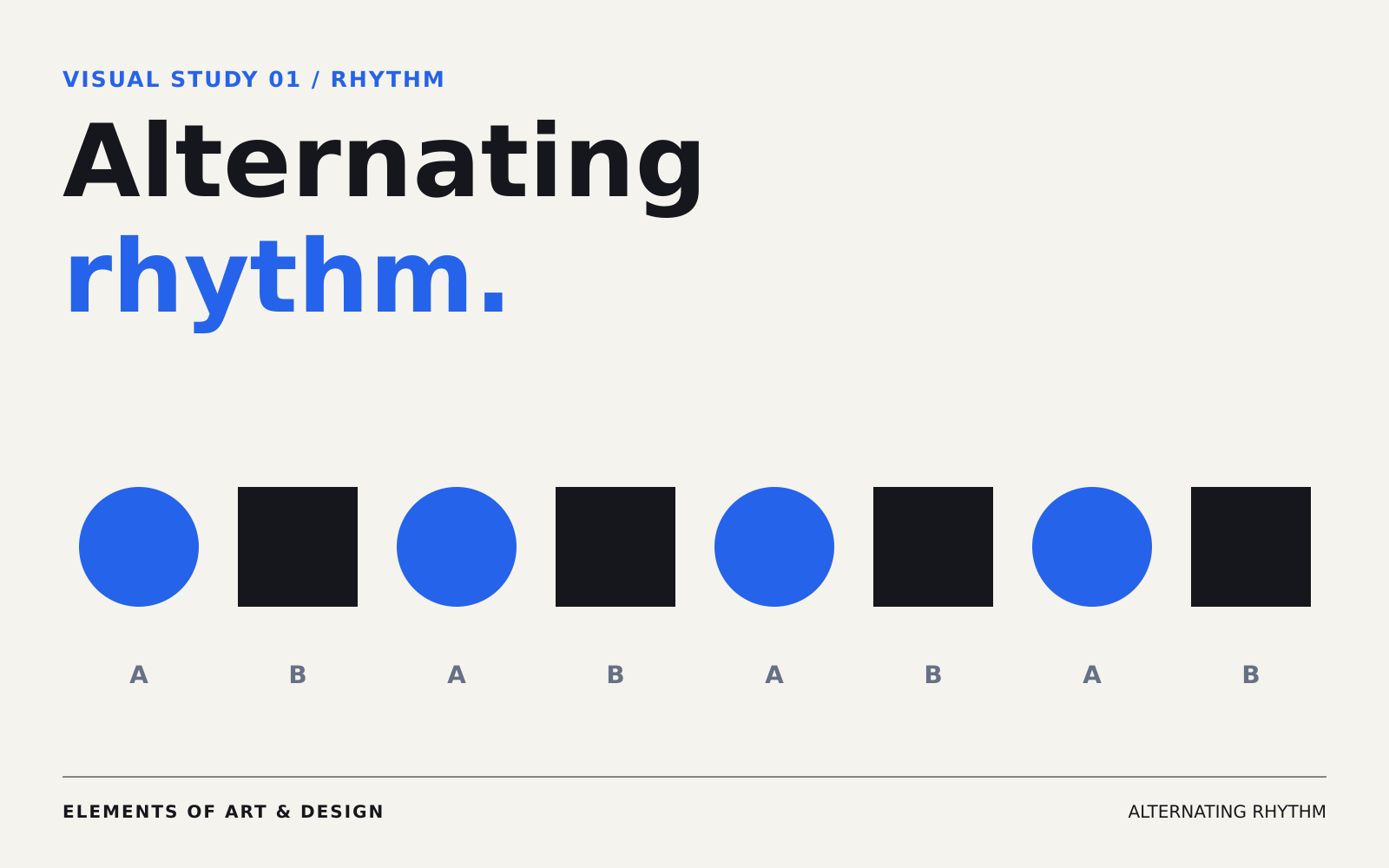
Look at the sequence above: a blue circle, a dark square, then another circle and square. After two pairs, you can predict which shape will be next. That expectation is part of how you perceive alternating rhythm.
You can find alternating rhythm in a textile border, a tiled floor, or a row of windows. Compare both the repeating order and the spacing. The same circle-square sequence can look evenly spaced or grouped in pairs, depending on the intervals between shapes.
What is alternating rhythm in art?
In alternating rhythm, two or more distinct visual elements or variations recur in a repeating order. The simplest example is A B A B. A and B might be different shapes, different colors, or two orientations of the same motif.
Look for a recognizable difference and a consistent repeating order. In a row of unrelated marks, you may see differences without being able to predict the next mark. With alternation, you can identify a repeating unit.
The Getty includes rhythm among the principles artists use to organize visual elements.1 Here, we focus on one particular arrangement of recurrence: alternation.
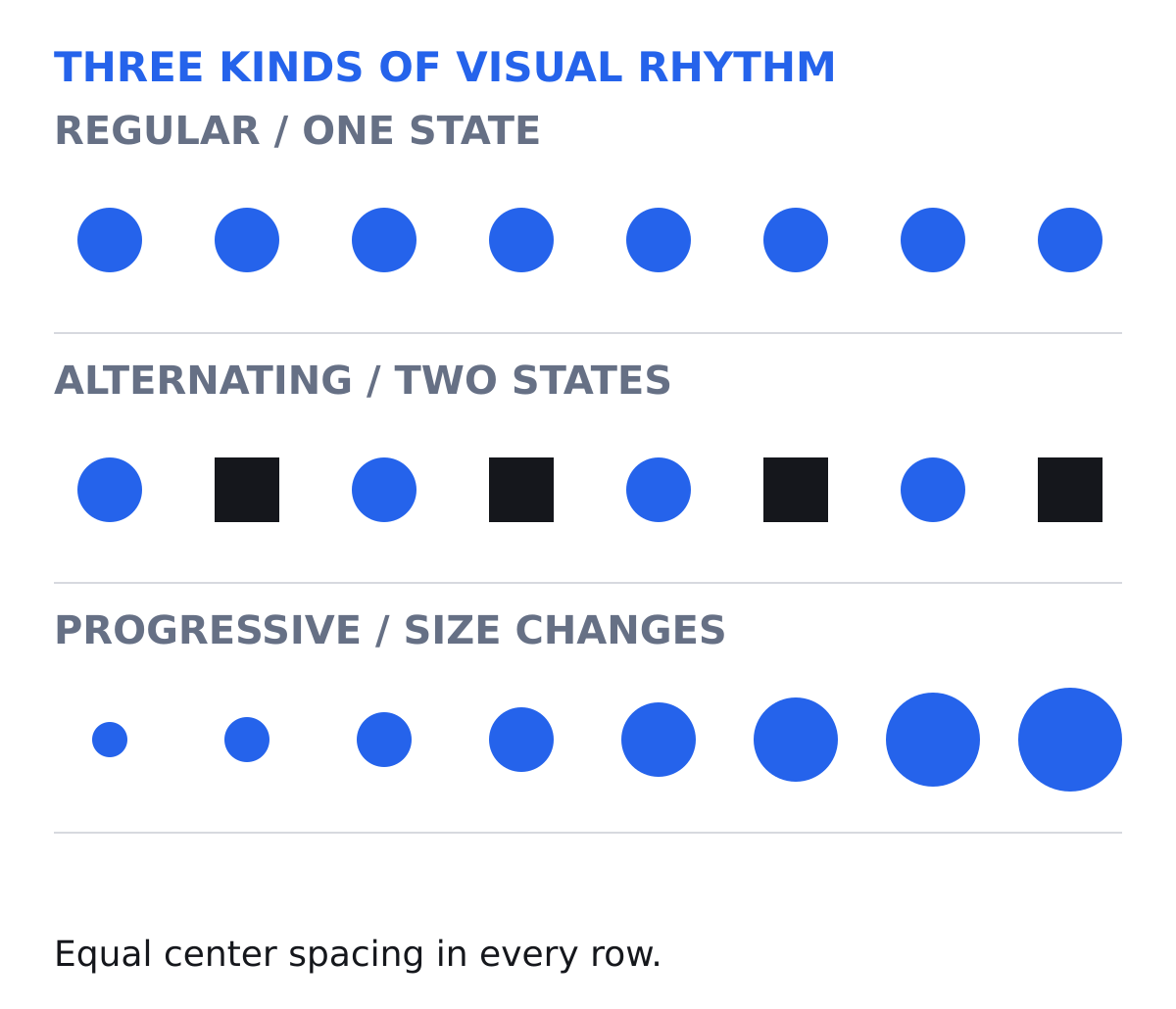
Alternate one attribute of a shape
You do not need a circle and a square. Try one leaf pointing upward, then the same leaf pointing downward. The two orientations are visually distinct. Or keep every shape and position identical while alternating filled and outlined versions.
This is useful when you want to understand a complicated work. Name the changing attribute before naming the effect. Does the sequence alternate hue, size, orientation, position, or something else? If several things change together, identify which attribute makes the repeating unit easiest to identify.
A sequence can also repeat a larger unit, such as A A B, A A B. Describing that unit is often more informative than forcing the work into a tidy label. Use these terms to describe what you can see, even when the arrangement combines several kinds of repetition.
Compare the spacing between repeats
Keep A and B in the same order and change the intervals between their centers. Equal intervals give every position a similar place in the sequence. Move A and B closer together and leave a wider space before the next pair. The pair can begin to read as a unit.
The order remains the same, but the grouping changes. A description such as “the shapes alternate” identifies the repeating order. To describe the rhythm more fully, compare the intervals within and between groups.
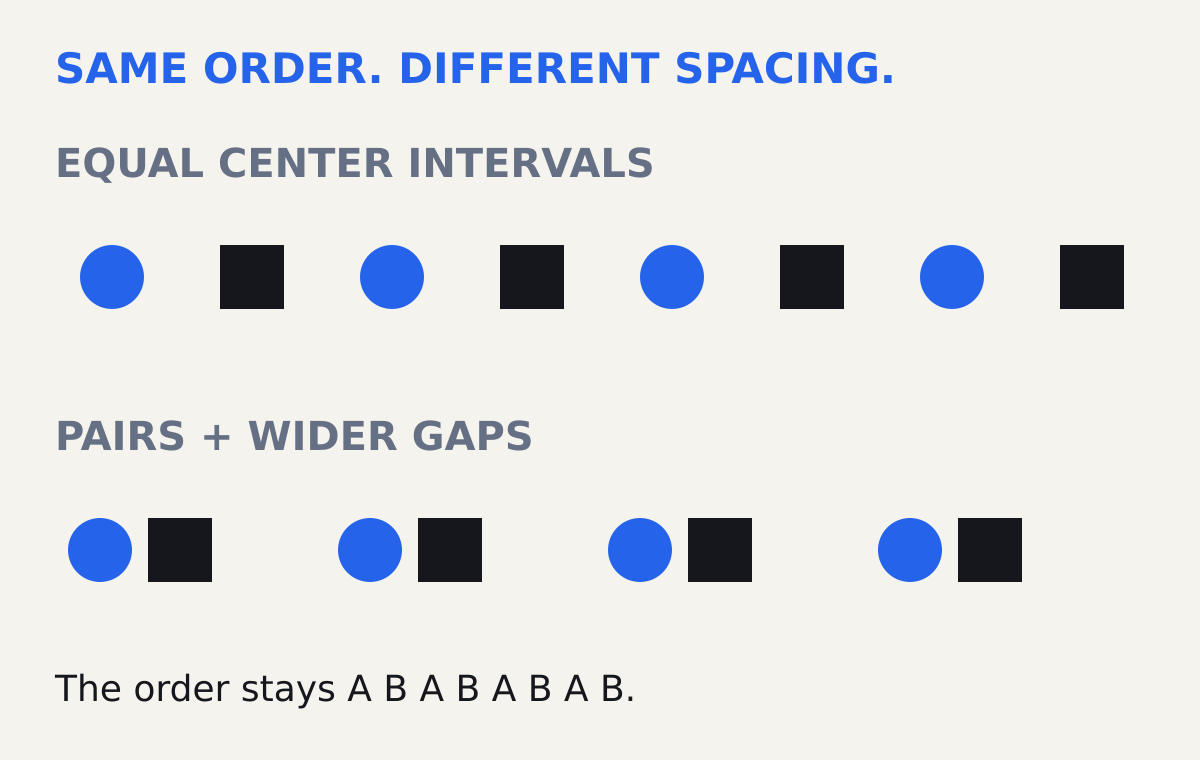
Look first: what changed between these two rows?
The shape order, shape sizes, and colors stay fixed. The center intervals change. The second row groups each circle with the following square, then leaves a wider gap before the next pair.
Look closely at an 1840 textile design
An unidentified Alsatian designer painted this small gouache textile design in 1840. It is now in the Metropolitan Museum of Art.2 The fanlike palmettes alternate between upward and downward orientations across a brown ground. Pale clusters of three dots recur among the forms.
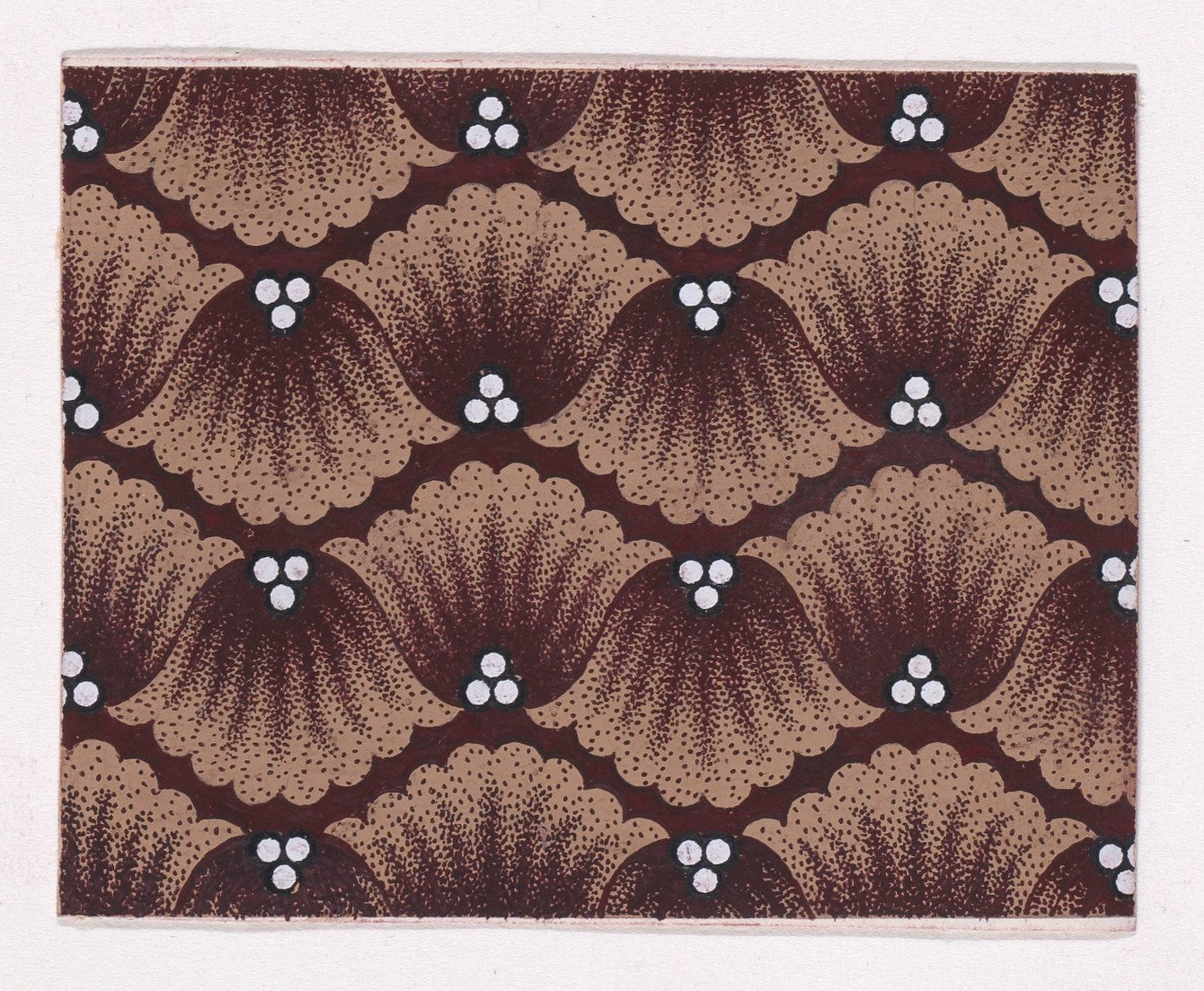
Choose one horizontal band and follow the orientation of its palmettes from left to right. Then compare the forms vertically. You can identify more than one sequence in the same pattern, depending on the direction you follow.
That is our visual reading of the design. Its date, attribution, material, and collection details come from the museum record; the observation does not establish what its maker intended.
Distinguish pattern, rhythm, and movement
When analyzing pattern, identify the repeating system. For rhythm, compare recurrence, intervals, and accents. For movement, describe how you look through the composition or what action is depicted.
You can make all three observations in the palmette design. Identify the repeating unit, describe the alternation and spacing within a band, and trace the order in which you notice forms across the surface.
TRY THIS / FIVE MINUTES
Compare order and spacing.
Draw eight equal marks at evenly spaced centers. Change every second mark in one way: fill, orientation, or shape. Redraw the sequence with close pairs and wider spaces between pairs. Finally, replace one shape to interrupt the alternating order.
Write one sentence for each version. Name what repeats, which interval changes, and where the alternating order is interrupted. Continue in the Rhythm lesson, where you can experiment with a sequence.
Sources and image credit
- J. Paul Getty Museum Education, “Landscapes, Classical to Modern” worksheet, “Principles of Design” section. Educational definitions of rhythm and related principles.
- The Metropolitan Museum of Art, object record 710057. Artwork identification, date, material, credit, and public-domain image status.
Original diagrams and visual analysis: Neura Collective. Museum images are reproduced without recoloring.