You look at a painting and immediately think you know what is happening.
The figure looks lonely. The red feels angry. The empty chair must represent loss. The artist is obviously trying to say something about isolation. Maybe.
But before deciding what an artwork means, there is a better question worth asking:
What is actually there?
It sounds simple, but it isn’t. Looking is not the same as interpreting, and the human brain is remarkably quick to turn one into the other. We recognize faces, construct stories, assign emotions, and search for meaning almost automatically.
Those abilities help us navigate the world. They can also cause us to overlook the visual evidence right in front of us.
Learning to look carefully means slowing that process down.
Start with what you can see
Consider Edward Hopper’s Cape Cod Evening from 1939.
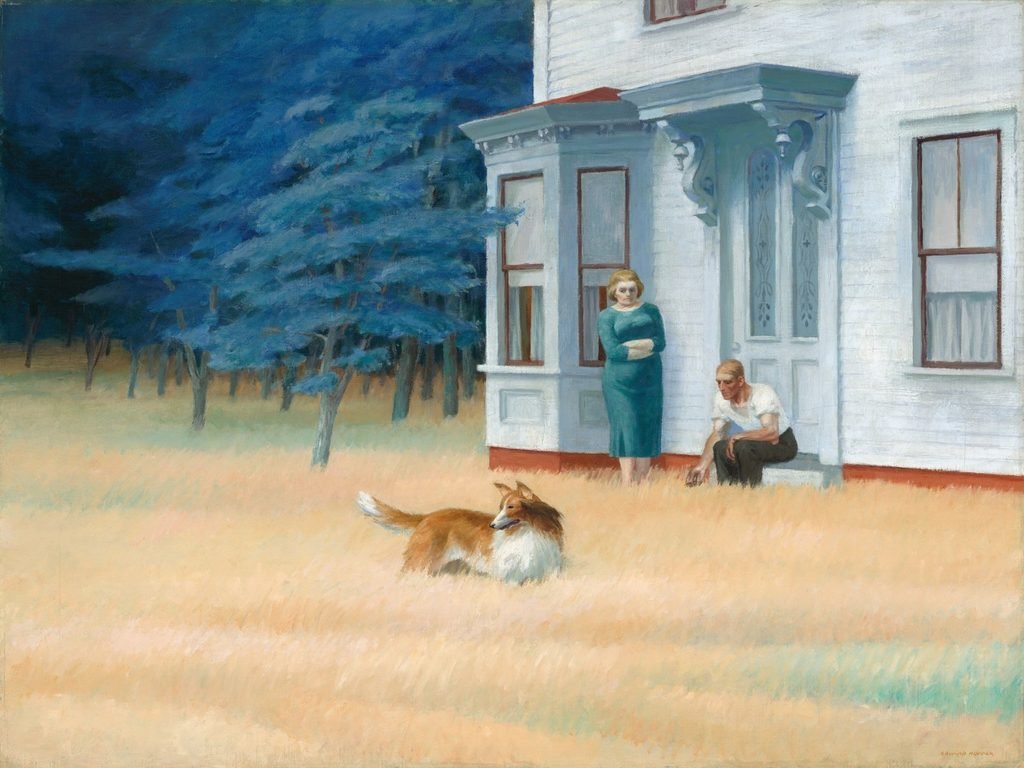
A woman stands outside a white house with her arms folded. A man sits on the doorstep. He reaches toward a dog standing in tall grass. The dog looks away from both people toward something outside the picture. Behind them, a dense grove of trees forms a dark mass against the house.
Those are observations. Now consider another description: The couple seems emotionally distant. The woman appears withdrawn. Something feels ominous. The dog senses trouble approaching.
Those are interpretations. They aren’t unreasonable ones. Hopper has arranged the figures so that they seem strangely disconnected from one another, and the contrast between the orderly white house, the overgrown grass, the dark trees, and the fading daylight contributes to an uneasy atmosphere.
But the distinction matters. We can point to folded arms, spatial separation, dark trees, tall grass, and an alert dog. We cannot point to “emotional distance” in the same way.
That interpretation is something we construct from the evidence. And the story becomes more interesting when we learn how Hopper made the painting.
Cape Cod Evening is not a record of a particular moment he witnessed. Hopper explained that he assembled it from sketches and remembered impressions of places around Cape Cod. The house, trees, figures, and grass came from different observations. According to Hopper, the dog may simply be listening to a whip-poor-will or another evening sound.
The ominous thing we imagined outside the frame may be a bird. That doesn’t make our response to the painting wrong. It reminds us that a feeling produced by an artwork and a fact about what it depicts are not the same thing.
Description is already analysis
Description can sound like the easy part of looking at art, something to get through before reaching the supposedly more sophisticated question of meaning. But careful description is a form of analysis.
Instead of asking only What is depicted?, ask how the image has been constructed. Where does your eye go first? Which shapes dominate the composition? Where are the darkest and lightest values? Is the space crowded or open? Do lines lead your eye somewhere? Are forms repeated? Does one color appear in several places? What is sharply defined, and what disappears into the background?
These observations reveal relationships, and relationships are where much of visual communication happens. The elements of art give us a vocabulary for noticing these things. The principles of design help us understand how they work together.
Look for relationships, not just objects
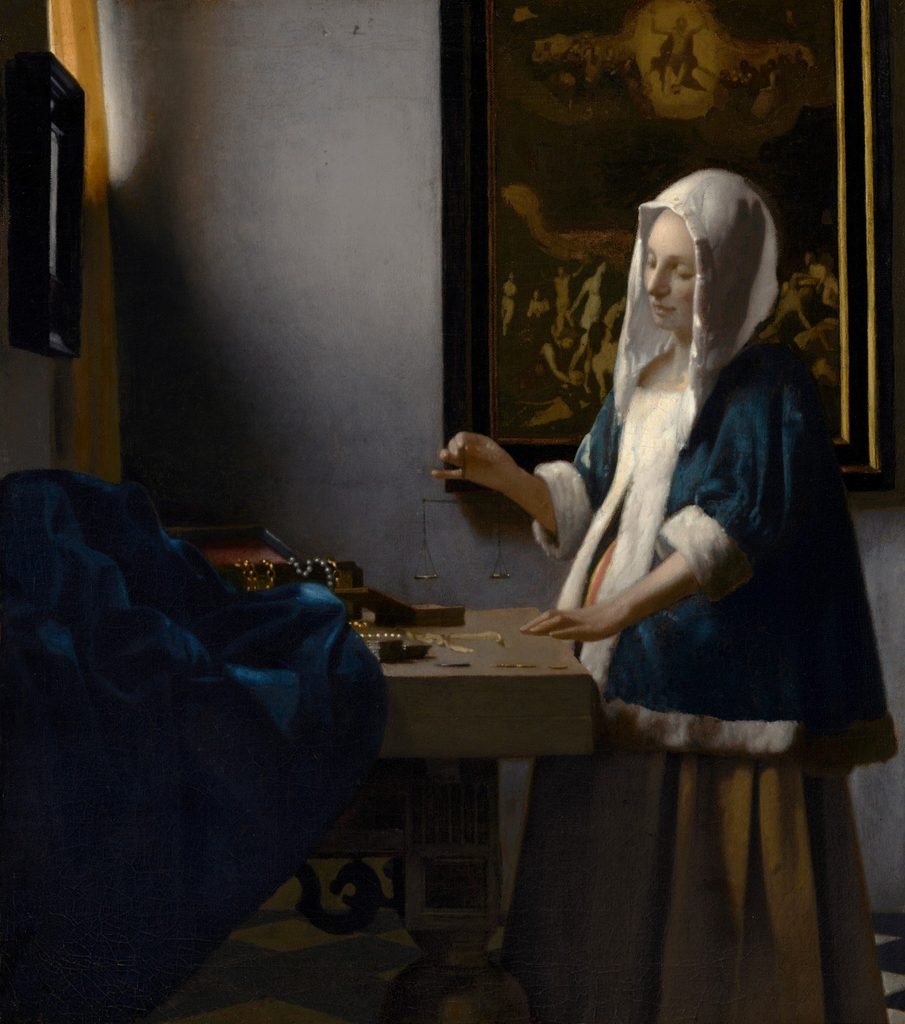
Johannes Vermeer’s Woman Holding a Balance, painted around 1664, offers a wonderful example.
Begin without interpreting it.
A woman stands beside a table in a dimly lit room. Soft light enters from a window. She holds a small balance in one hand. On the table are boxes, pearls, and a gold chain.
Behind her hangs a large painting. Look more closely.
The painting depicts the Last Judgment. Now the objects begin to form relationships.
A balance occupies the space before a scene of divine judgment. Earthly riches lie on the table beneath them. The woman’s hand and the delicate scale become a focal point within an otherwise quiet composition.
Nothing had to be added to the painting for its possibilities to become richer. We simply noticed more.
The National Gallery of Art interprets these relationships in terms of judgment, conscience, temperance, and moderation. The woman stands visually between material treasures and an image concerned with eternal judgment.
Whether a viewer arrives immediately at that interpretation is less important than understanding how it is built.
The balance is there. The riches are there. The Last Judgment is there. Their placement in relation to one another is there.
Interpretation begins when we investigate what those relationships might mean.
Your first impression still matters
Careful looking doesn’t require you to suppress your response to an artwork. Quite the opposite.
If a painting makes you uncomfortable, notice it. If a photograph feels strangely peaceful, notice that too. If a sculpture makes you laugh, your reaction is part of your encounter with the work.
Then ask a more useful question:
What in the work might be producing that response?
Perhaps a composition feels peaceful because its visual weight is unusually balanced. A sculpture might be funny because its proportions violate what you expect a body to look like. A painting might feel tense because strong diagonals repeatedly push your eye toward the edge of the frame.
Now an instinctive response has become the beginning of an investigation.
Context can change what you see
Sometimes visual analysis can take us a long way. Sometimes learning the history behind an artwork changes how we see it.
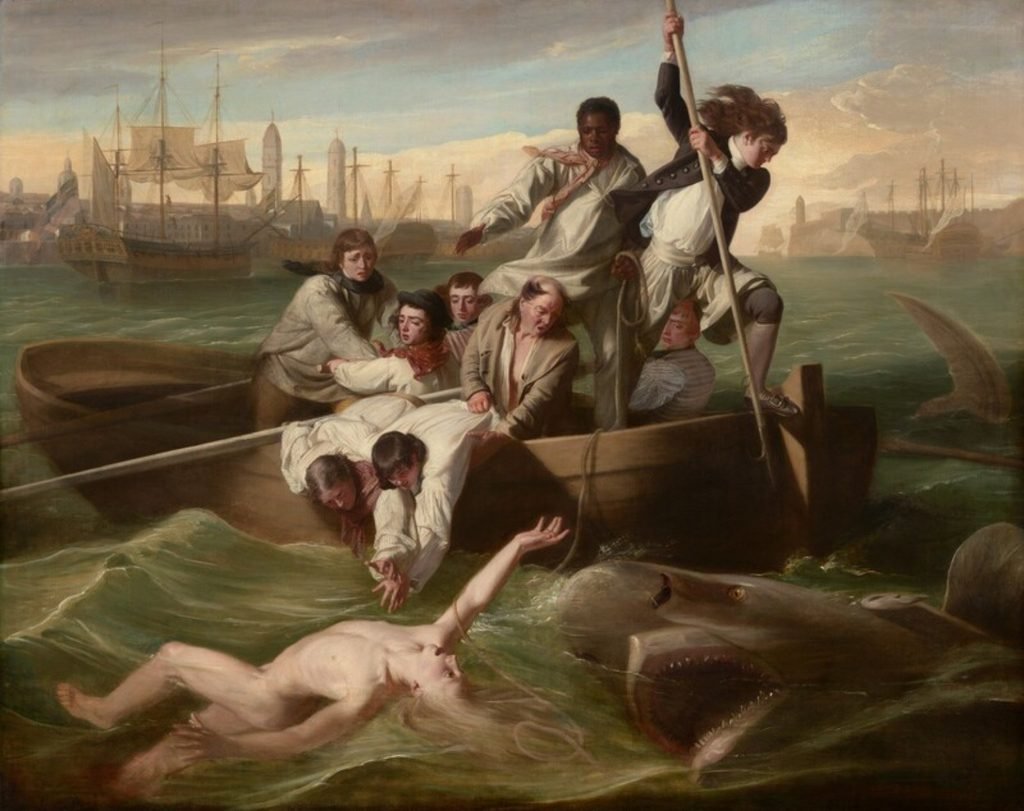
John Singleton Copley’s Watson and the Shark, painted in 1778, seems at first remarkably direct.
A shark attacks a young man in the water. Sailors crowd into a small boat trying to rescue him. Bodies lean, reach, twist, and pull in different directions. A harpoon points toward the shark. The composition is filled with diagonals and gestures that amplify the scene’s urgency.
It looks like a dramatic rescue because it is one. But then comes the context: the event really happened.
In 1749, 14-year-old Brook Watson was attacked by a shark while swimming in Havana Harbor. He survived the attack but lost part of his right leg. Decades later, after becoming a successful merchant, Watson commissioned Copley to paint the event.
Suddenly we are not simply looking at a dramatic scene. We are looking at a man commissioning an image of his own survival.
Then another detail demands attention.
Near the top of the composition stands a Black sailor holding the rope connected to Watson. His elevated position and central role are visually striking, and the National Gallery of Art notes how unusual such prominence was for a Black figure in 18th-century European painting.
Havana was also a major center of the transatlantic slave trade. And Watson himself later served in Parliament and voted against abolition of the slave trade.
None of those facts can be discovered merely by studying Copley’s use of line, value, or composition. But once we know them, we look again.
The Black sailor was visible all along. The rope was visible. His position within the composition was visible. What changed was our ability to understand why those observations might matter.
Context did not replace looking. It compelled us to look more carefully.
Interpretation is an argument
There is rarely a single sentence hidden inside an artwork waiting to be decoded. Interpretation is better understood as an argument based on evidence.
You notice something, you notice something else, you discover relevant context, and then you ask whether those pieces support an idea.
This is also why two people can construct different interpretations of the same artwork without every interpretation being equally convincing.
One viewer might see Hopper’s Cape Cod Evening primarily as a picture of interpersonal isolation. Another might focus on the tension between the cultivated house and encroaching nature. Another might concentrate on the dog’s attention to a world beyond the human figures.
Each interpretation can be explored. But the question remains: What evidence supports it?
That question separates interpretation from guessing.
Try looking twice
The next time you encounter an artwork, give yourself two passes. On the first pass, postpone meaning.
Look at line, shape, form, color, value, texture, space, scale, repetition, contrast, balance, and placement.
Describe what you can actually point to. Then look again.
Ask what those visual choices might be doing. Consider your emotional response. Investigate the historical context. Look for relationships you missed the first time.
Then form an interpretation. You may arrive at exactly the same conclusion you had in the first few seconds.
But now you will know why. And sometimes something better happens.
The artwork changes because you finally noticed what had been there all along. Nothing on the canvas moved.